

Updated for 2026. Driving up to Teide is one of Tenerife’s great experiences, but it is worth doing with up-to-date information. Not because it is difficult, but because Teide National Park has mountain roads, sudden weather changes, car parks that fill up and mobility measures that are evolving during 2026.
The good news is that you can reach Teide by road from several parts of the island. The key is to choose the right route for where you are staying, leave early and know beforehand what you can do without a permit and what requires a reservation.
This guide is designed to explain exactly that: which road to take, where to stop, when a permit is required, how the cable car works and what to check before starting the car.
In this guide you will find:
- The best route for driving up to Teide from each area.
- Access via La Orotava, La Esperanza, Vilaflor and Chío.
- What to see on the way and where to stop.
- Information about the cable car, the summit permit and parking.
- Restrictions and mobility changes planned during 2026.
- Driving, weather and safety advice.
Can you drive up to Teide in 2026?
Yes, you can drive up to Teide on the main roads through the National Park. You do not need a permit to enter the park or travel on roads open to traffic. You do need to plan the day carefully, because the most popular areas become congested and Tenerife Island Council is introducing control measures to manage access and parking.
You should also distinguish between three things that are often confused:
- Driving up to Teide National Park: you can travel there by road whenever the roads are open.
- Taking the cable car to La Rambleta: you need to buy a cable-car ticket.
- Reaching the summit of Teide: you need a specific permit for the Telesforo Bravo trail, except on authorised activities that include it.
Check the roads and cable-car status before setting out. There may be ice or snow in winter; in summer, expect heavy traffic and full car parks. Teide is not an ordinary road: it is high mountain terrain.
What is the best route for driving up to Teide?
There is no single “best route”. It depends on your starting point and the landscape you want to see. This quick table will help you choose:
| Starting from | Recommended route | Why choose it |
|---|---|---|
| Puerto de la Cruz, La Orotava or the north | TF-21 via La Orotava and Aguamansa | The most direct climb from the north, through woodland, pine forest and volcanic scenery. |
| La Laguna or Santa Cruz | TF-24 via La Esperanza | One of the most beautiful roads, with viewpoints and pine forest before El Portillo. |
| Los Cristianos, Costa Adeje or the south | TF-21 via Vilaflor or TF-38 via Chío | Vilaflor offers a village and pine forest; Chío is convenient for volcanic scenery and descending towards the west. |
| Los Gigantes, Alcalá or Guía de Isora | TF-38 via Chío | Practical from the west, entering the park at Boca Tauce. |
For a circular route, my favourite option is to go up on one road and come down on another. From the north, for example, climb via La Orotava and descend through La Esperanza. From the south, go up through Vilaflor and down through Chío. You avoid repeating the scenery and the day feels more complete.
Official road entrances to Teide National Park
There are four main road entrances:
- TF-21 from La Orotava: starts in the north and reaches El Portillo.
- TF-24 from La Laguna and La Esperanza: crosses the ridge and connects with El Portillo.
- TF-21 from Granadilla and Vilaflor: climbs from the south to Boca Tauce.
- TF-38 from Chío in Guía de Isora: enters from the west towards Boca Tauce.
These entrances match the official Teide National Park information. Even so, check the roads before climbing, especially after rain or snow, or when there is a wind alert.
Route to Teide from the north: La Orotava and Puerto de la Cruz
If you are staying in Puerto de la Cruz, La Orotava, Los Realejos or Santa Úrsula, the logical route is the TF-21. From La Orotava you gain altitude through Aguamansa, enter pine forest and watch the landscape gradually become volcanic.
It is a beautiful climb, but also a winding road. There is no need to hurry. Teide is more enjoyable when you stop at viewpoints and allow the landscape to do its work.
Recommended stops from the north
- La Orotava: a good place for breakfast or to buy water before climbing.
- Aguamansa: a cool, green area where the change in climate becomes obvious.
- El Portillo: the natural entrance to Las Cañadas when coming from La Orotava.
- Minas de San José: pale, almost lunar and highly photogenic scenery.
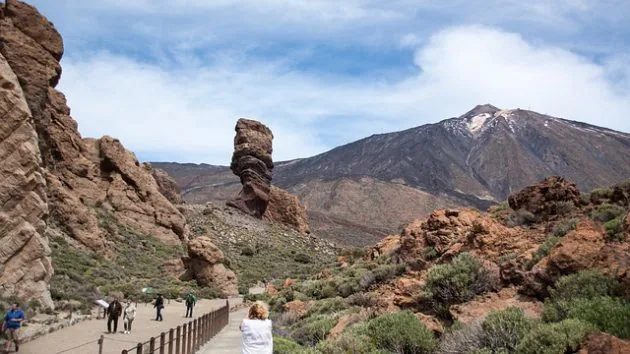
- Roques de García: one of the park’s most famous stops.
Advice: leave early when coming from Puerto de la Cruz. You need not set off at dawn as though joining a polar expedition, but you should avoid arriving at Roques de García just when everyone else has had the same idea.
Route from La Laguna and Santa Cruz: the La Esperanza road
From Santa Cruz or La Laguna, the climb on the TF-24 is wonderful. The road passes La Esperanza and crosses beautiful pine forest before opening onto the park’s volcanic landscape.
This route is highly recommended for viewpoints, the sea of clouds and the feeling of a scenic drive. It is also good for a circular route: climb through La Esperanza, cross the park and descend through La Orotava or towards the south.
Recommended stops on the TF-24
- Ridge viewpoints: perfect when there is a sea of clouds.
- La Tarta area: famous for the coloured strata in the volcanic rock.
- El Portillo: a good place to get your bearings before continuing to the cable car or Roques de García.
- Minas de San José: an easy and rewarding photograph stop.
On very busy days, some viewpoints may have controls or restrictions. If there is no space, continue to the next authorised parking area. Parking illegally at Teide is not worth the safety risk or the fine.
Route to Teide from the south: Vilaflor or Chío
From Costa Adeje, Los Cristianos, Playa de las Américas, El Médano or Golf del Sur, you have two main choices: climb through Vilaflor or Chío.
Climbing through Vilaflor on the TF-21
The Vilaflor route is beautiful if you want to pass through one of Tenerife’s highest towns and climb gradually through pine forest and bends. It is a good choice from the south or south-east if you want to combine Teide with a stop in the town.
From Vilaflor, the road continues to Boca Tauce and enters the open landscape of Las Cañadas. It feels like a journey through the island, with changing vegetation along the way.
Climbing through Chío on the TF-38
The TF-38 from Chío is very practical from the west or Costa Adeje if you want a broad, comfortable road with volcanic scenery. It enters at Boca Tauce and provides easy access to Roques de García, the Parador and the cable car.
For many people staying in the south, climbing through Vilaflor and descending through Chío—or the reverse—is a very convenient combination. You see two different faces of Teide.
What to see at the top: Roques de García, cable car and viewpoints
Once inside the National Park, do not rush around trying to see everything. Choose three or four stops and enjoy them properly.
- Roques de García: an essential stop with views of Teide and Llano de Ucanca.
- Minas de San José: pale volcanic scenery unlike the rest of the island.
- Teide Cable Car: climbs to La Rambleta, more than 3,500 metres above sea level.
- Pico Viejo viewpoint: accessible from the upper cable-car station when conditions allow.
- La Fortaleza viewpoint: another option from the upper station, with views towards the north.
- Llano de Ucanca: one of the park’s broadest and most photogenic panoramas.
When travelling with children, older people or anyone sensitive to altitude, ascend gradually. You can feel the elevation up there. Drink water, avoid sudden exertion and do not turn every viewpoint into a race.
Do you need a permit to climb Teide?
Not to drive into the National Park. You do need one to reach Teide’s summit.
The permit is required for the Telesforo Bravo trail, the section from La Rambleta, the upper cable-car station, to the summit. It is free but places are limited and demand is high. Arrange it in advance through Tenerife ON or the booking service indicated by the National Park.
Important: buying a cable-car ticket does not automatically include a summit permit. The cable car leaves you at La Rambleta. From there you can visit freely accessible viewpoints when they are open, but you need a permit to set foot on the summit.
Teide Cable Car: what you need to know
The cable car is the easiest way to gain altitude without a demanding hike. The base station is beside the TF-21 and the upper station is at La Rambleta, more than 3,500 metres above sea level.
Bear the following in mind:
- Buy a timed ticket online.
- Check the cable-car status that day, as it may close because of wind or weather.
- If you want to reach the summit, coordinate your cable-car time and permit.
- Do not have rigid expectations: weather rules in the high mountains.
The official cable-car website publishes opening times and the status of the facilities, trails and car park. In 2026, for example, the base-station car park is shown with extended summer hours, but these times change by season. Always check before setting out.
Where to park at Teide
Parking is one of the difficult points. There are designated areas at viewpoints, Roques de García, around the Parador, Minas de San José and the cable-car base station, but they fill up at peak times.
Practical advice:
- Arrive early. It remains the best trick and it still works.
- Do not park outside authorised areas. It damages the environment and may result in a fine or your vehicle being removed.
- Have a backup plan. If Roques de García is full, continue elsewhere and return later.
- Check mobility changes. Parking reservations, quotas and controls in high-traffic areas are under consideration during 2026.
If you are using the cable car, check the base-station car-park hours. Outside those times, access may be limited to authorised experiences.
Restrictions and mobility changes in 2026
This is a key point. Teide receives vast numbers of visitors, and the authorities are taking steps to reduce congestion, organise parking and control sensitive areas.
Measures announced or prepared in 2026 include:
- Traffic controls and penalties for illegally parked vehicles.
- Advance booking in high-traffic areas.
- Parking quotas at the main access points.
- Greater control at viewpoints such as Roques de García, Chipeque and Minas de San José.
- Gradual reinforcement of public transport and shuttle buses.
The practical point is this: check official sources on the day before climbing. Do not rely only on something you read weeks earlier, because rules may change due to the season, roadworks, weather or congestion.
Checklist before driving up to Teide
- Check road conditions through the Island Council or Road Information Centre.
- Check the cable-car status if you have a ticket.
- Confirm whether you need a summit permit and whether your time slot matches the cable car.
- Bring water, warm clothing, sunglasses and sun protection.
- Fill up with fuel before climbing if the tank is low.
- Do not hurry or stop on unauthorised verges.
- With a hire car, check its basic condition and remain on paved roads open to traffic.
Driving advice for the route to Teide
Teide’s roads are paved and perfectly passable when open, but they are not motorways. Expect bends, changing light, cyclists, buses, viewpoints, distracted tourists and sometimes fog or ice.
- Use lower gears on long descents to avoid overworking the brakes.
- Do not cross into the opposite lane on bends, even when the road appears empty.
- Respect cyclists and motorcyclists.
- Do not stop in the road to take photographs.
- Change your plans if there is ice, snow, strong wind or an alert.
It may sound like common sense, but at Teide, common sense is part of your luggage.
How long do I need to visit Teide by car?
Allow at least half a day for a relaxed visit. If you leave early, you can drive up, stop at several viewpoints, visit Roques de García and return to the coast by mid-afternoon.
If you also want the cable car, a summit permit, a trail or a circular route, set aside the whole day. Between driving, parking, waiting, altitude and photographs, Teide always takes more time than it appears. We forgive it, because what a spectacle it is.
Recommended itineraries
Quick route from the north
Start in Puerto de la Cruz or La Orotava, climb on the TF-21 and stop at Aguamansa, El Portillo, Minas de San José and Roques de García. Return on the same road or descend on the TF-24 towards La Laguna.
Scenic route from Santa Cruz or La Laguna
Climb on the TF-24, visit the ridge viewpoints, El Portillo, Minas de San José and Roques de García, use the cable car if you have a ticket, and descend through La Orotava or Vilaflor depending on your plans.
Route from the south
Climb through Vilaflor, stop in the town, then continue to Boca Tauce, Llano de Ucanca, Roques de García and the cable car if booked, before descending through Chío. This is a very complete route from Los Cristianos, Costa Adeje or Playa de las Américas.
Route from the west
Climb through Chío to Boca Tauce, Roques de García and Minas de San José, then return on the TF-38 or descend through Vilaflor for a change.
Frequently asked questions about driving up to Teide
Can I drive up to Teide in a hire car?
Yes, provided you stay on paved roads open to traffic and follow the rules. Do not enter closed tracks or unauthorised areas.
Do you have to pay to enter Teide National Park?
In 2026, there is no general tourist entrance fee for entering the National Park by road. The cable car, certain experiences, parking if new systems are activated and regulated access to specific areas may require payment or booking.
Which is the most beautiful road to Teide?
The TF-24 through La Esperanza is one of the most scenic. The TF-21 through La Orotava is the classic route from the north. From the south, climbing through Vilaflor and descending through Chío makes a beautiful circular route.
Do I need a permit to reach the summit?
Yes. You need a permit for the final section to the summit along the Telesforo Bravo trail. A cable-car ticket alone does not authorise you to reach the peak.
Where can I check whether the roads are open?
Check the Tenerife Island Council Road Information Centre, National Park information and cable-car status if you plan to use it.
Is it better to drive up in the morning or afternoon?
Parking and organising your visit are usually easier in the morning. The light can be beautiful in the afternoon, but you must plan your descent and the cable-car or parking times carefully.
Driving up to Teide is one of those plans that justifies hiring a car in Tenerife. It gives you the freedom to stop, change route, wait for a viewpoint to clear and descend on a different side of the island. When you take your time and check that day’s information, it is one of the most beautiful routes you can drive in the Canary Islands.
If you are preparing a route around the island, you can see car hire options in Tenerife and organise the day without depending on a fixed excursion.